Pipeline and SIMD optimization
Transformed-vertex caching, light pre-normalization, Early-Z, backface culling, and incremental edge functions reduce redundant work. SoA data and AVX operations batch transforms and eight-pixel shading.
Recorded results
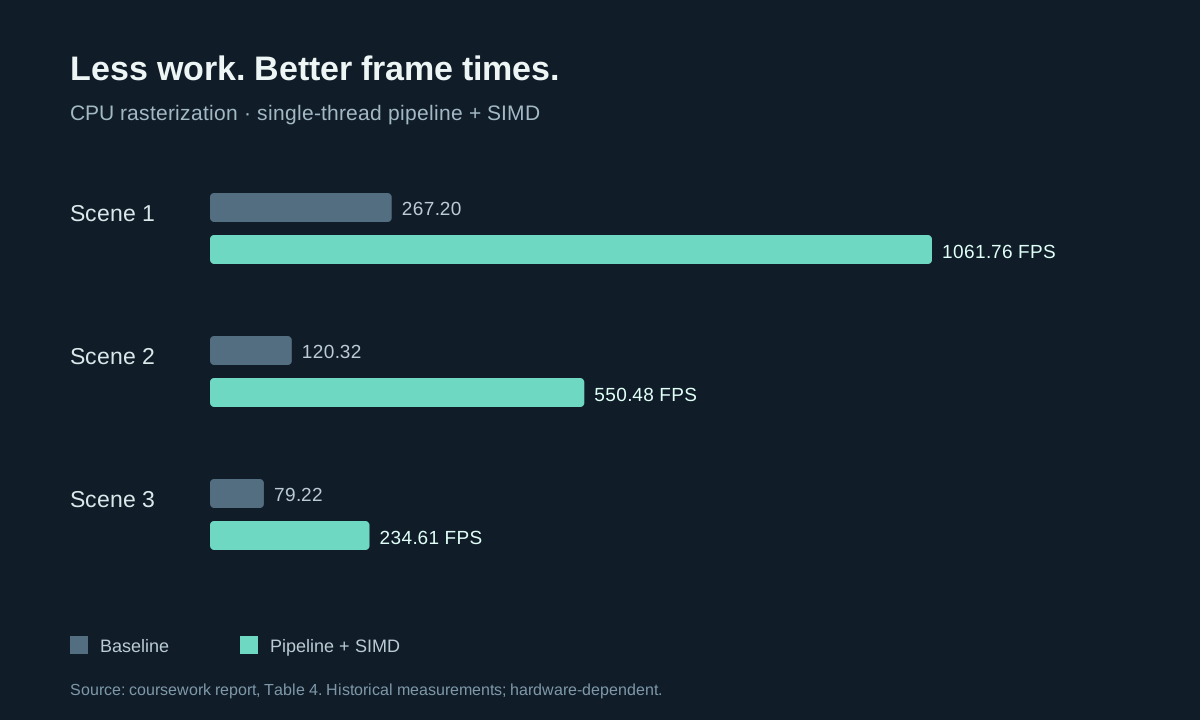
Historical single-thread pipeline + SIMD measurements from report Table 4. Ratios are recalculated from FPS and do not include an additional multithreading speedup.
| Scene | Baseline FPS | Optimized FPS | Ratio | P99 (ms) |
|---|---|---|---|---|
| 1 | 267.20 | 1061.76 | 3.97× | 6.17 → 1.57 |
| 2 | 120.32 | 550.48 | 4.58× | 10.37 → 2.54 |
| 3 | 79.22 | 234.61 | 2.96× | 14.76 → 5.53 |
P99 frame time decreased by approximately 63–76%. These development-machine observations are hardware-dependent; reproduction requires fixed scene, resolution, compiler, and sampling settings.
Parallelism tradeoffs
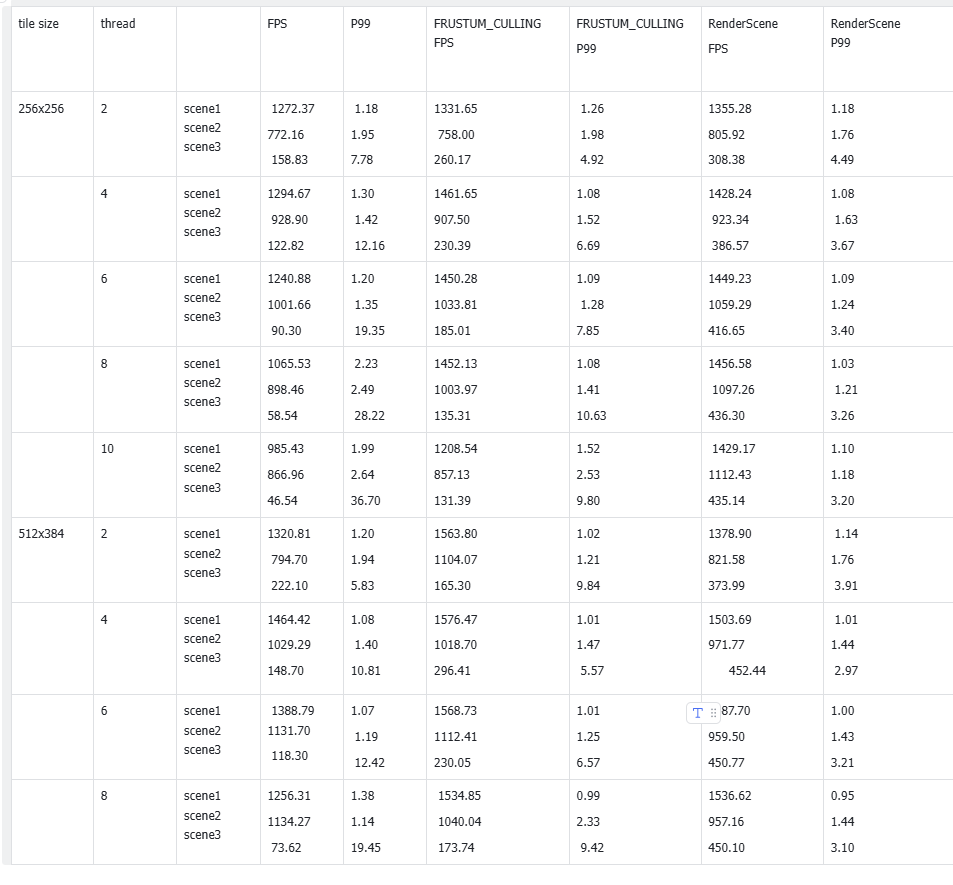
A thread pool dispatches screen tiles, sharing read-only inputs while separating color/depth writes. Experiments vary worker count, tile size, and culling strategy to inspect scheduling and load balance. More threads are not always faster.